

Shopify & Ecommerce
Your Digital Foundation: Choosing the Right Platform with a Web Design Company in Amman Jordan
Shopify or WordPress: what each platform does best, and how to choose the right foundation for your website in Jordan.
7 min read
Who we help
Your industry, your market
By industry13 industries
Luxury & retail5
Ecommerce & tech3
Food & hospitality1
Services & lead generation4
Not listed? Most of what we run carries across. Ask on WhatsApp (opens in a new tab)
All industriesAll marketsProof
Real numbers, real screenshots
Every number comes from a published AlGurus case, with a platform screenshot.
All 29 case studiesCompany
The team behind the results
Since 2018 · Um Uthaina, Amman
About AlGurus
A results-driven digital marketing agency in Amman, helping businesses in Jordan, the Gulf and beyond grow online since 2018. One certified team for ads, websites, SEO and GEO.
Google Premier, Meta, Shopify, Salla
Certified partners
 Google Premier Partner2026 · top 3% worldwide
 MetaBusiness Partner
 Shopify Partnersince March 2020
 SallaPartner
SEO & GEO checkup, ad analyzer
Audits reviewed by our team
Send your website or your ads dashboard. Our team reviews each request and emails you a branded PDF audit.
Since 2018 · Um Uthaina, Amman
Talk to us
MenuBy industry
By market





 Google Premier Partner2026 · top 3% worldwideMetaBusiness PartnerShopify Partnersince March 2020SallaPartner
 AlGurus Academy (opens in a new tab)ToolsSEO & GEO checkup, ad analyzer
Contact
Services open from the bottom bar
Services · Goal finder
What do you want to grow?
Your growth path4 services, in the order we’d start
Your growth path4 services, in the order we’d start
Your growth path4 services, in the order we’d start
Your growth path4 services, in the order we’d start
Your growth path4 services, in the order we’d start
Your growth path4 services, in the order we’d start
Your growth path4 services, in the order we’d start
Real result
Top 3%
of Google Partners worldwide — we’re a Google Premier Partner
See the case studiesBook a strategy callYour growth pathTwo ways to learn
Real result
13+
years running real campaigns — now taught at Algurus Academy
Visit Algurus AcademyBook a strategy callPaid AdsTurn ad spend into measurable revenue.10 services
Most requested
Open Paid AdsOrganic TrafficRank on Google, Maps, app stores and AI answers.4 services
Most requested
Open Organic TrafficWeb DevelopmentFast stores and sites built to convert.6 services
Most requested
Real result
326K JOD
in Shopify sales for a hardware store
75+ Shopify stores built
See the case studiesSocial Media ManagementContent and community that keep you top of feed.3 services
Most requested
Open Social Media ManagementGraphic DesignA brand people recognise in one scroll.4 services
Most requested
Open Graphic DesignConsultationSenior eyes on your ads, store and growth plan.5 services
Most requested
Open ConsultationTrainingLearn it from the team that runs it — via Algurus Academy.Algurus Academy
Courses at Algurus Academy
 Google PartnerPremier 2026MetaBusiness PartnerShopifyPartnerSallaPartnerOur partnerships
Markets:KSAUAEIraqQatarKuwaitUSACanadamore soon
WhatsAppOne app, two stores, built to last.
Android and iOS apps for businesses in Jordan and the Gulf. Cross-platform with Flutter or React Native for most projects, native Swift and Kotlin when the app needs it, with Arabic, local payments, store launch and updates after launch included.
// one screen, both platforms
class HomeScreen extends Screen {
  Widget build(ctx) => AppScaffold(
    title: t.home, // AR + EN
    body: Column(children: [
      NextVisitCard(visit),      ServicesGrid(services),
      BookButton(onTap: book),
    ]),
    nav: AdaptiveTabs('home'),
  );
}
AlGurus develops mobile apps for Android and iOS in Amman, Jordan. Most apps are built cross-platform with Flutter or React Native, so one codebase serves both stores; we build natively in Swift and Kotlin when performance or device features require it. Every app includes Arabic and English, local payment options where needed, an admin panel, store submission and an update plan after launch.
People keep only a handful of apps they open every week. A business app earns that place when it does something faster or better than a website: booking in two taps, reordering a favourite, tracking a delivery, showing a membership card, or getting a timely notification. Before we design anything, we check that an app is the right answer, because for some businesses a fast mobile website does the job at a fraction of the cost.
When an app is the right answer, we build it as a product: designed for both platforms, connected to the systems that run your business, launched properly on both stores and kept up to date as Apple and Google change their requirements every year.
Clinics, salons, gyms and services: availability, booking, reminders, payments and visit history.
Restaurant ordering, retail and companion apps for Shopify or Salla stores, sharing products, stock and customers.
Digital cards, points, tiers, offers and referral programmes that bring customers back.
Apps for drivers, technicians and sales teams, connected to your business system, with offline mode.
Account, orders, documents, support and notifications for service, education and real estate companies.
A focused first version to test the idea with real users, built so it can grow instead of being rewritten.
For most business apps, a cross-platform framework is the right choice. Flutter and React Native let one team write one codebase that runs on both Android and iOS, which usually means a faster launch, a lower build cost and simpler updates. Native development, with Swift for iOS and Kotlin for Android, means two codebases, but it gives full access to every platform feature and the best possible performance. We look at four things before recommending either. Answer the questions to see where your app probably sits.
One codebase for both stores will cover your needs with room to spare. You launch on Android and iOS together and every update ships to both at once.
Build the app cross-platform and write the few demanding parts, such as a hardware integration or a heavy animation, as native modules in Swift and Kotlin. This is a common and effective middle path.
Your app leans on performance, deep device features or long-term platform-specific teams. Two native codebases will cost more, but they give you full control on each platform.
Booking, ordering, content and account screens run smoothly cross-platform. Heavy graphics, AR, complex video or real-time processing are where native earns its cost.
Camera, location, notifications and biometrics are well supported in both frameworks. Specialised hardware, wearables or heavy background work may need native code.
One codebase usually means a faster, leaner launch and cheaper updates. Two native apps roughly double the build and maintenance effort.
If web developers will maintain the app, React Native fits their skills. If you plan dedicated iOS and Android teams, native suits them.
Most business apps are assembled from a familiar set of features. What makes them work in Jordan and the Gulf is the detail: phone-number sign-in, local payment methods, proper Arabic, and notifications that respect people instead of spamming them. Choose a feature to see how we approach it.
Most users in the region expect to sign in with their mobile number and a one-time code, not a new password. We combine phone OTP with Sign in with Apple and Google sign-in, plus Face ID or fingerprint for returning users. When an app offers third-party sign-in, Apple's review guidelines require an equivalent privacy-focused option, so we plan for that from the start.
We integrate card payments through payment gateways that operate in your markets, Apple Pay and Google Pay where supported, local options such as mada cards in Saudi Arabia, and cash on delivery when your customers still prefer it. For physical goods and services, payments run through your gateway; for digital content and subscriptions, Apple and Google require their own in-app purchase systems, and we design the business model around that rule.
Push notifications are an app's biggest advantage over a website, and the fastest way to get uninstalled if they are misused. We separate useful transactional messages, such as order updates and appointment reminders, from marketing messages, let users choose what they receive, and send in the user's language and time zone.
Addresses in Amman, Riyadh or Dubai are often described by landmarks rather than street numbers. We let customers drop a pin, save labelled locations such as home and work, and add notes for the driver. Location also powers branch finders, delivery zones, live driver tracking and check-ins for field staff.
Both Flutter and React Native support right-to-left layouts, but a good Arabic app still needs design decisions: which icons mirror and which do not, Arabic fonts that render well at small sizes, numbers and prices displayed the way your customers expect, and store listings written for each language rather than translated.
Drivers in basements, technicians on site and sales staff on the road lose connection often. Offline mode stores data on the device, lets people keep working, and syncs changes safely when the connection returns, with clear rules for conflicts.
An app is not launched until both stores approve it. Apple reviews every release against its App Review Guidelines, and Google Play has its own policies and requirements, including up-to-date target API levels. Rejections usually come from missing details rather than big problems, so we work through a checklist like this one before every submission. Tick items to see your progress.
Every useful app depends on a backend: the server, database and API that hold users, orders, bookings and content, and the admin panel your team uses to manage them. We build this as part of the project, or connect the app to systems you already run, such as your Shopify or Salla store, your booking software or your ERP.
The admin panel is where the app is really run day to day: editing content and offers, handling orders, sending notifications and seeing what users do. When your operations need more than that, the same backend can power a full custom business system or a custom dashboard that puts app data next to sales and marketing.
Apple and Google release new operating system versions every year and update their store policies regularly, so an app that is not maintained slowly breaks or gets removed. And an app nobody installs helps nobody. After launch we keep the app healthy and, if you want, our marketing teams help it grow.
A care plan covers compatibility with new iOS and Android versions, framework and library updates, store policy changes, crash monitoring and security fixes.
It also includes hours for improvements, so the app keeps evolving with what users ask for and what the analytics show.
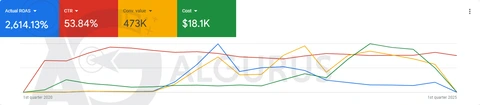
Google App campaigns bring installs from Search, Play, YouTube and the Display network. A result from our app advertising work, not app development:
Titles, keywords, screenshots and ratings in Arabic and English, so people searching the App Store and Google Play find your app and choose to install it.
Explore ASODownloads alone say little. These are the measures we set up from the first release and review with you every month.
Crash and error reports per version and device, with fixes prioritised by impact.
How many people come back after installing, by acquisition source.
The share of users who book, order or sign up within their first sessions.
Average rating and review themes on both stores, in both languages.
Since 2018 AlGurus has worked with more than 120 brands in Jordan, Saudi Arabia, the UAE, Qatar, Iraq, the USA and Canada. We run app install campaigns, store optimisation, websites and online stores, so we build apps knowing how they will be found, installed and used.
Google Premier Partner status covers the app install campaigns that often follow a launch; Meta Business Partner and Shopify Partner status cover the ads and stores many of our apps connect to.
App development examples and references are shared on your strategy call, under NDA where a client asks for it.
We release early and often. A testable build reaches your phone within the first sprints, and real users test the app before the public launch.
Goals, users and the core journey. We confirm an app is the right answer and choose cross-platform or native.
Scope · tech choiceScreens for iOS and Android conventions, in Arabic and English, as a clickable prototype tested with users.
Figma prototypeApp, backend and admin panel in two-week sprints, with test builds on your phone after each one.
TestFlight · test tracksTesting on real devices and OS versions, a beta with real users, then performance and security checks.
Device matrix · betaListings, privacy details and submission to both stores, handling any reviewer questions.
App Store · Google PlayStaged rollout, monitoring, then regular updates and new features under a care plan.
Care plan · roadmapThe app is published under your own Apple and Google developer accounts, the source code sits in your repository and the backend runs in your cloud account. If you later build an in-house mobile team, they inherit a documented project, not a dependency on us.
We hand over design files, build and release instructions, and access to crash reporting and analytics, and we stay on through a care plan for updates and improvements.
Every screen, in Arabic and English, with a clickable prototype.
Published on Google Play and the App Store under your accounts.
Or integration with the systems you already run.
Events, funnels and stability monitoring from day one.
Repository, build steps and release process documented.
OS updates, store policy changes, fixes and improvement hours.
An app is a bigger commitment than a website: two stores, yearly platform updates and the work of persuading people to install it. It pays back for some businesses and not for others.
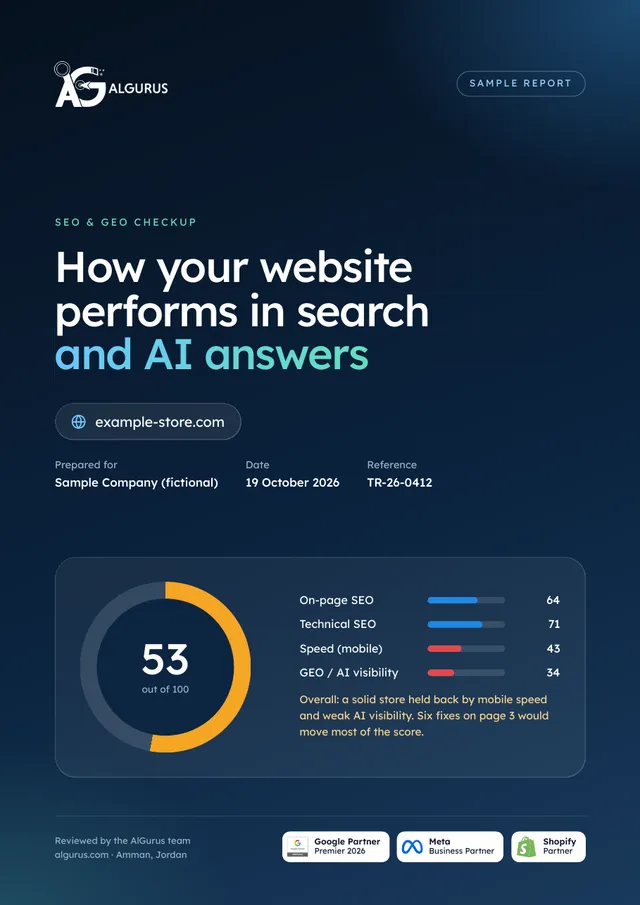
Send us your website. Our team reviews its speed, technical health and how it shows in Google and AI answers, and the audit arrives in your inbox with a plain-language fix for each issue.
Shopify or WordPress: what each platform does best, and how to choose the right foundation for your website in Jordan.
7 min read
The four paid-media shifts shaping Jordan in 2026: AI-run Meta campaigns, TikTok as search and shop, automated Google bidding, and Snapchat AR.
9 min read
Ten common digital marketing mistakes, from no strategy to no tracking, and the best practice that fixes each one.
7 min readLeave your details. We reply on WhatsApp or by phone between 7 AM and 10 PM Amman time, with a first plan within one working day.
The team will contact you between 7 AM and 10 PM Amman time. Want to talk now? Send it on WhatsApp in one tap.
Reference:
Yes. Most apps we build launch on both Google Play and the Apple App Store at the same time. With a cross-platform framework one codebase serves both; with native development we build a Swift app for iOS and a Kotlin app for Android.
Both are mature and well supported. Flutter gives very consistent visuals across platforms and strong performance; React Native suits teams with JavaScript and web experience and can share logic with a React website. We recommend one per project based on the design, the features and who will maintain it.
When the app depends on demanding graphics, AR, complex video or real-time processing, on deep or new device features, on heavy background work, or when you plan separate long-term iOS and Android teams. Often a cross-platform app with a few native modules gets most of the benefit at lower cost.
Cost depends on the number of screens and features, cross-platform versus native, whether a backend and admin panel are needed, and the integrations involved. A focused MVP is a much smaller project than a full ordering or booking platform. We fix the scope and price of the first release after discovery.
Timelines depend on scope. Discovery and design come first, development runs in two-week sprints with test builds on your phone throughout, and store review adds time before launch. We share a dated plan at the start and recommend launching a focused first version rather than waiting for every feature.
Yes. We integrate card payments through gateways operating in your markets, Apple Pay and Google Pay where available, local card schemes such as mada in Saudi Arabia, and cash on delivery. Digital goods and subscriptions must use Apple and Google in-app purchases under store rules, and we plan the model accordingly.
Yes. Apps are designed for Arabic right-to-left and English from the start, with an in-app language switch, Arabic fonts and input, and separate store listings and screenshots for each language.
Yes. We prepare listings, screenshots, privacy and data safety details and review notes, submit to both stores under your developer accounts, and handle any questions from reviewers. Future updates go through the same process.
A care plan keeps the app compatible with new iOS and Android versions, current with store policies, monitored for crashes and secure, with hours for improvements. Our App Ads and ASO teams can also help the app get installs and rank in store search.
You do. The app is published under your company's developer accounts, the code is in your repository and the backend runs in your cloud account, with documentation for any future team.







Book a strategy call. Bring the idea, a sketch or an app you admire. We will tell you whether an app or a mobile website is the better first step, whether cross-platform or native fits, and what a focused first release could include.