

Shopify & Ecommerce
10 Signs Your Shopify Store Needs a Redesign (and What to Do About It)
Ten signs your Shopify store has outgrown its design, reskin vs rebuild, and how to redesign without losing SEO.
8 min read
Who we help
Your industry, your market
By industry13 industries
Luxury & retail5
Ecommerce & tech3
Food & hospitality1
Services & lead generation4
Not listed? Most of what we run carries across. Ask on WhatsApp (opens in a new tab)
All industriesAll marketsProof
Real numbers, real screenshots
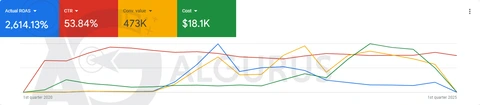
Every number comes from a published AlGurus case, with a platform screenshot.
All 29 case studiesCompany
The team behind the results
Since 2018 · Um Uthaina, Amman
About AlGurus
A results-driven digital marketing agency in Amman, helping businesses in Jordan, the Gulf and beyond grow online since 2018. One certified team for ads, websites, SEO and GEO.
Google Premier, Meta, Shopify, Salla
Certified partners
 Google Premier Partner2026 · top 3% worldwide
 MetaBusiness Partner
 Shopify Partnersince March 2020
 SallaPartner
SEO & GEO checkup, ad analyzer
Audits reviewed by our team
Send your website or your ads dashboard. Our team reviews each request and emails you a branded PDF audit.
Since 2018 · Um Uthaina, Amman
Talk to us
MenuBy industry
By market





 Google Premier Partner2026 · top 3% worldwideMetaBusiness PartnerShopify Partnersince March 2020SallaPartner
 AlGurus Academy (opens in a new tab)ToolsSEO & GEO checkup, ad analyzer
Contact
Services open from the bottom bar
Services · Goal finder
What do you want to grow?
Your growth path4 services, in the order we’d start
Your growth path4 services, in the order we’d start
Your growth path4 services, in the order we’d start
Your growth path4 services, in the order we’d start
Your growth path4 services, in the order we’d start
Your growth path4 services, in the order we’d start
Your growth path4 services, in the order we’d start
Real result
Top 3%
of Google Partners worldwide — we’re a Google Premier Partner
See the case studiesBook a strategy callYour growth pathTwo ways to learn
Real result
13+
years running real campaigns — now taught at Algurus Academy
Visit Algurus AcademyBook a strategy callPaid AdsTurn ad spend into measurable revenue.10 services
Most requested
Open Paid AdsOrganic TrafficRank on Google, Maps, app stores and AI answers.4 services
Most requested
Open Organic TrafficWeb DevelopmentFast stores and sites built to convert.6 services
Most requested
Real result
326K JOD
in Shopify sales for a hardware store
75+ Shopify stores built
See the case studiesSocial Media ManagementContent and community that keep you top of feed.3 services
Most requested
Open Social Media ManagementGraphic DesignA brand people recognise in one scroll.4 services
Most requested
Open Graphic DesignConsultationSenior eyes on your ads, store and growth plan.5 services
Most requested
Open ConsultationTrainingLearn it from the team that runs it — via Algurus Academy.Algurus Academy
Courses at Algurus Academy


 Google PartnerPremier 2026MetaBusiness PartnerShopifyPartnerSallaPartnerOur partnerships
Markets:KSAUAEIraqQatarKuwaitUSACanadamore soon
WhatsAppSame products. Same URLs. A store that finally sells.
We rebuild Shopify stores that already have products, customers and traffic, but look dated, load slowly or lose buyers between the ad and the checkout. A full rebuild on a duplicate theme, Arabic and English, tracking your ads can learn from, and your URLs kept so search rankings stay.
AlGurus redesigns existing Shopify stores in Amman, Jordan and for brands selling across the Gulf. A redesign is a full rebuild, not a new coat of paint: we audit the current store, design a new theme and design system, rebuild the mobile shopping experience in Arabic and English, clean up apps, and rebuild GA4, Meta and Google Ads tracking. Products, customers, orders and URLs stay, and the new theme is built on a duplicate so the store never goes offline.
Most of the stores we redesign are not broken. They take orders every day. But they were set up years ago on a theme that has been patched by several people, they carry apps nobody remembers installing, and they were designed for desktop English shoppers while the real customers now arrive on a phone, often from an Instagram or Snapchat ad, and often reading Arabic.
If two or more of the signs below sound familiar, a redesign usually pays for itself faster than another round of patches.
Your products, packaging and social content have moved on, but the store still looks like the theme you picked at launch. Customers judge quality in the first seconds.
Traffic reaches product pages and then leaks: unclear prices, hidden delivery costs, a weak add-to-cart button, or a cart that sends people away.
Heavy images, sliders and stacked app scripts make the first screen slow, especially on a phone. Every second of waiting costs attention and ad budget.
Popups, badges, size charts, sliders and widgets each add a script and a monthly fee, and some keep loading code long after they were uninstalled.
Flipped layouts, mixed fonts, arrows pointing the wrong way, or no Arabic at all. Mobile menus, filters and carts squeezed down from desktop.
Click costs are fine and ads get attention, but the page they land on does not match the ad, loads slowly or cannot report purchases back properly.
A reskin swaps fonts, colours and banners on top of the same theme, the same apps and the same tracking. It looks new for a week and inherits every old problem. A redesign at AlGurus is a full rebuild of everything customers touch, which is why we scope and price it like a new store build. The difference shows up in speed, in conversion and in the data your ads receive.
| Area | Reskin | AlGurus redesign |
|---|---|---|
| Starting point | The current theme, as it is | A conversion audit of the current store and its data |
| Design | New colours, fonts and banners | New design system and every template redesigned |
| Theme code | Old code and old patches kept | Clean Online Store 2.0 theme, sections your team can edit |
| Apps | All kept, often more added | Each app reviewed, replaced in theme code or removed |
| Arabic | Translated text in an LTR layout | Native right-to-left templates and Arabic typography |
| Tracking | Whatever was installed before | GA4, Meta CAPI and Google Ads conversions rebuilt and tested |
| SEO | Usually untouched, sometimes broken | URLs kept, redirects mapped, structured data improved |
Every redesign covers the same nine areas. The depth of each one depends on what the audit finds, the size of your catalogue and the markets you sell to.
Analytics, funnel drop-off by device and page type, a heatmap-style review of how people scroll and tap, and a page-by-page list of what is losing buyers.
Colours, type, spacing and components defined once and applied to home, collection, product, cart, search, pages and blog, in Figma before code.
Product pages, collections with usable filters, a cart drawer that explains delivery and payment, and checkout-adjacent steps designed for thumbs first.
Responsive image pipeline, lazy loading below the fold, fewer fonts and scripts, and an app review that removes what the theme can now do itself.
Native right-to-left templates, paired Arabic and Latin fonts, translated navigation, product content, emails and notifications, and correct hreflang.
Cash on delivery, local wallets and cards for Jordan, Mada and instalments for Saudi Arabia, delivery zones and rates by city and country.
GA4 ecommerce events, Meta pixel with Conversions API, Google Ads conversions with enhanced conversions, deduplicated and tested before launch.
Product and collection handles kept, any changed URL redirected, titles and descriptions carried over, structured data and sitemaps checked.
Built and tested on a duplicate theme while the live store keeps selling, then published in one click at a quiet hour, with the old theme kept as a backup.
A redesign that starts from taste ends up as a reskin. Ours starts from your data. We read your Shopify analytics and GA4 funnel, split it by device, traffic source and language, and review recordings and heatmap-style scroll and tap patterns on your key templates. Then we walk the store the way a customer does: from an ad, on a phone, in Arabic and in English.
Pick a stage of the funnel to see what the audit looks at and what usually changes in the redesign.
We compare your top ads and search queries with the pages they land on. Visitors who clicked a specific product or offer should see that product or offer immediately, in the language of the ad, with price and delivery visible without scrolling.
We also measure how fast the first screen appears on a mid-range phone, and check for popups, cookie bars and chat widgets that cover the product before the visitor has seen it.
We review navigation depth, collection structure, sorting and filters on mobile. Common leaks are filters hidden behind several taps, products without prices or sizes on the grid, and collections that mix unrelated items.
The redesign usually brings a clearer menu, filters built on Shopify's native search and discovery, quick-add for simple products and product cards that show what matters for your category.
We look at photo quality and order, variant selection, how price, delivery time and payment options are shown, whether reviews and guarantees are visible, and whether the add-to-cart button stays within thumb reach.
Product pages get the most redesign time, because that is where an ad click becomes a decision. We design them for the questions your customers actually ask your team on WhatsApp.
Delivery fees appearing late, unclear cash on delivery rules, coupon fields that send people searching for a code, and upsell apps that slow the cart all show up clearly in drop-off data.
We design a cart that states delivery cost and timing, shows the payment methods available in the customer's country and keeps upsells relevant and light.
Shopify's checkout is secure and fast, so we focus on what surrounds it: trust signals before checkout, payment and shipping settings, order confirmation emails and WhatsApp notifications in the right language.
We also verify that every purchase is reported correctly to GA4, Meta and Google Ads. Missing or duplicated purchase events are one of the most common findings, and they quietly make ads more expensive.
A redesign happens inside your existing Shopify store. Nothing is exported and re-imported, so the records that matter to your business are never at risk. What changes is everything the customer sees and everything that runs in their browser.
Untouched by the redesign, because it lives in your Shopify admin, not in the theme.
Designed, coded and tested on a duplicate theme before anyone sees it.
Older Shopify stores slow down gradually. Each new feature arrives as an app, each app adds its own script and styles to every page, and uninstalled apps often leave code behind in the theme. Large product photos are uploaded straight from the camera, and sliders load several full-size images before the visitor sees one.
During the redesign we review every installed app with you. Apps that do real work, such as reviews, subscriptions or delivery integrations, stay. Features the new theme can handle natively, such as size charts, badges, sticky add-to-cart or announcement bars, are rebuilt in theme code. Abandoned code is removed. The result is a store that is quicker on mobile and usually cheaper to run every month.
Images go through Shopify's responsive image pipeline in modern formats, sized per screen, with the main product image loaded first and everything below the fold loaded only when needed. We test on real mid-range phones, not only on a fast office connection.
A store that converts in Jordan and the Gulf needs more than a translated menu. Arabic shoppers expect a layout that reads naturally from right to left, payment options they trust, and delivery information they can rely on before they commit. We design these into the templates instead of adding them as apps afterwards. Which payment methods you can switch on depends on your business registration and the providers approved for your store; we help with that setup.
Cash on delivery stays the most trusted option for many Jordanian shoppers, so the cart explains it clearly. Delivery zones and fees are set by governorate and city, with timing shown on the product page.
Mada and instalment options are shown where they influence the decision, on the product page and in the cart, not only at checkout. Prices, duties and delivery times are set per market.
Shopify Markets handles currencies and languages per country, with prices and shipping rates that make sense locally and URLs that search engines can tell apart.
Navigation, carousels, progress steps and arrows mirror correctly, while prices, phone numbers, sizes and product codes stay left to right as Arabic readers expect.
An Arabic font paired with your Latin brand font, with sizes and line heights set separately, so product names and descriptions are comfortable to read on a phone.
Order confirmations, shipping updates and abandoned cart emails translated and designed, so the experience stays consistent after the customer pays.
Meta, Google and Snapchat decide who sees your ads based on the conversion data your store sends back. When that data is incomplete because of browser blocking, or doubled because two apps fire the same purchase, the platforms learn from the wrong signals and every sale costs more. A redesign is the right moment to rebuild tracking cleanly, because the theme code is changing anyway.
We set up GA4 ecommerce events, the Meta pixel with the Conversions API, Google Ads conversion tracking with enhanced conversions and, where you advertise there, the Snapchat pixel and Conversions API. Browser and server events share an event ID so the platforms count each purchase once. Then we place test orders and confirm every event in each platform before launch.
| Event | GA4 | Meta CAPI | Google Ads | Snapchat |
|---|---|---|---|---|
| View productview_item · ViewContent | audience | |||
| Add to cartadd_to_cart · AddToCart | ||||
| Begin checkoutbegin_checkout · InitiateCheckout | ||||
| Purchasepurchase · Purchase, deduplicated | ||||
| WhatsApp clickcustom lead event | optional | optional |
Product data matters too. We clean up product titles, variants, GTINs where you have them and product types, so your catalogue feeds Google Merchant Center and the Meta catalogue properly. That is what powers Shopping ads, Performance Max and dynamic product ads after launch.
The biggest risk in any redesign is losing the search traffic you already earned. Because a Shopify redesign stays on the same platform and the same domain, your product and collection URLs can stay exactly as they are, and in most projects they do. When the new structure needs a change, such as merging two thin collections or cleaning up a messy handle, every old URL gets a permanent redirect to its new address in Shopify's URL redirects.
Before launch we crawl the current store, export the pages that receive organic clicks and backlinks from Search Console, and check that each one still resolves on the new theme with the same title, description and main content. We also use the rebuild to fix what the old theme got wrong: duplicate collection URLs, missing product structured data, heading structure, image alt text and Arabic pages without hreflang.
After launch we watch Search Console for crawl errors and ranking changes in the weeks that follow, and fix anything that moves the wrong way quickly.
Sample store URLs for illustration
Shopify lets a store hold several themes at once, with only one published. We duplicate your live theme and build the redesign on that copy, so customers keep shopping on the current store throughout the project. You review the new store through a private preview link on your own phone, with your real products and prices.
When everything is approved and tested, we publish the new theme at a quiet hour. The switch takes seconds, there is no maintenance page and no lost orders. The old theme stays in your theme library as a backup, so rolling back is one click if anything unexpected appears.
Most of our redesign clients also run paid ads with us, and that is not a coincidence. An ad can only bring a customer to the door. The store is the place the customer lands, and it decides whether the click becomes an order. When the same team designs the store, writes the ad creatives and runs the campaigns, the product page matches the ad, tracking reports every purchase, and each improvement on one side makes the other side cheaper.
Meta, Google and Snapchat campaigns that send buyers to the right product or collection.
Videos and visuals designed with the same look as the new store, so the click feels continuous.
Collection and product pages that rank in Google and get cited in AI answers.
The place the customer lands. Fast, clear, bilingual and measured, so every channel around it performs better.
Server-side purchase events help Meta, Google and Snapchat find more buyers like your best ones.
Clean product feeds for Google Shopping, Performance Max and Meta catalogue ads.
One view of spend, sessions, conversion rate and order value, so decisions use the same numbers.
We have built more than 75 Shopify stores and managed more than $28M in ad spend for over 120 brands. The numbers below come from a single Shopify store we have built and grown with the owner over five years; they show the metrics we focus on in every redesign: conversion rate, order value and customers who come back.
A hardware store that sells online across Jordan, built and developed on Shopify with AlGurus. Its conversion rate and average order value are both above the hardware industry averages quoted in the case, and most buyers came back to order again.
Since 2018 AlGurus has worked with brands in Jordan, Saudi Arabia, the UAE, Qatar, Iraq, the USA and Canada. The team that redesigns your store also runs SEO and paid campaigns, so every store is built to receive traffic from day one.
A Shopify Partner for the store itself, and official partners of the two ad platforms most redesigned stores depend on for traffic.
Before and after examples from recent redesigns are shared on your strategy call, with client permission.
The length of a redesign depends on the number of templates, the size of the catalogue, the apps involved and whether Arabic is new. After the audit you receive a dated plan with review points, and progress is visible on the preview link throughout.
Analytics, funnel, recordings, speed, apps, tracking and SEO reviewed. Findings ranked by impact.
Audit report · prioritiesTemplates, navigation, collection structure, URL decisions, app list and markets agreed with you.
Scope · dated planDesign system and key templates in Figma, mobile and desktop, English and Arabic, approved before code.
Figma · prototypeThe new theme built on a duplicate, apps cleaned up, payments, shipping and translations configured.
Duplicate theme · preview linkTest orders, tracking checks in every platform, speed on real phones, redirects and SEO checks.
QA checklist · test ordersPublished at a quiet hour, monitored closely, then improved with your ads and SEO data.
Launch · monitoringAt the end of a redesign you have a new theme published on your store, documented and editable by your team through Shopify's theme editor. The design files, the audit and the tracking setup are yours, and nothing is locked to our accounts.
Most clients continue with us after launch, on paid ads, SEO or a monthly Shopify care plan for new landing pages, seasonal campaigns and ongoing improvements. That is optional; the store is fully yours either way.
Funnel, speed, apps, tracking and SEO findings, ranked by impact.
Every template in English and Arabic, mobile and desktop.
Online Store 2.0 sections your team can edit, old theme kept as backup.
GA4, Meta CAPI, Google Ads and Snapchat, tested with real orders.
Every changed URL redirected, structured data and hreflang in place.
Recorded walkthroughs for editing pages, products and campaigns.
A redesign is a real project, priced like a new store build. It is the right move in some situations and too much in others. If you recognise yourself on the right, we will say so on the call and suggest something smaller.
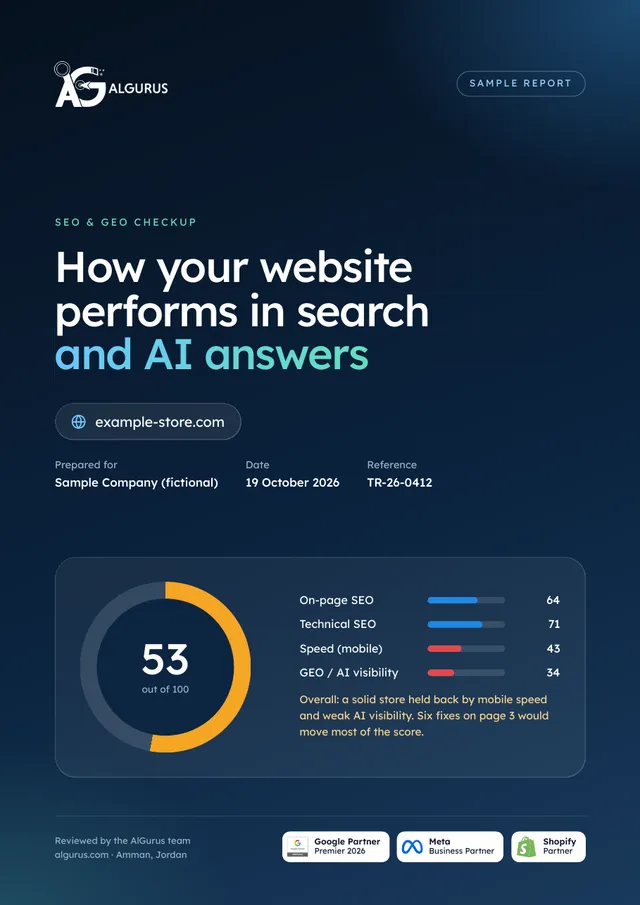
Send us your store link. Our team reviews its speed, technical health and how it shows in Google and AI answers, and the audit arrives in your inbox with a plain-language fix for each issue.
Ten signs your Shopify store has outgrown its design, reskin vs rebuild, and how to redesign without losing SEO.
8 min read
Plan prices, design paths, apps, payments, Arabic and support: what a Shopify store in Jordan costs once and every month.
9 min read
What a Shopify Partner does, what good development and support look like, and seven questions to ask before you hire one.
8 min readLeave your details. We reply on WhatsApp or by phone between 7 AM and 10 PM Amman time, with a first plan within one working day.
The team will contact you between 7 AM and 10 PM Amman time. Want to talk now? Send it on WhatsApp in one tap.
Reference:
No. A Shopify redesign changes the theme, not the store's data. Products, variants, inventory, customers, order history, discounts and gift cards live in your Shopify admin and are not touched. Nothing is exported or re-imported.
Not if the redesign is planned for SEO, which ours is. Product and collection URLs normally stay the same. Any URL that changes gets a permanent redirect, titles and descriptions are carried over, and we check the pages that bring organic traffic before and after launch in Search Console.
We rebuild it. A reskin changes colours and fonts on the same theme. Our redesign starts with a conversion audit, then rebuilds the design system, every template, the mobile experience, Arabic layouts, apps and tracking. That is why it performs differently, and why it is scoped like a new store.
Sometimes. If your current theme is a modern Online Store 2.0 theme with clean code, we can build the redesign on it and keep what works. If it is old, heavily patched or slow, starting from a clean, well-supported base is faster and safer. The audit tells us which, and we explain the reasoning.
No. We build on a duplicate theme while your current store stays live and keeps taking orders. You review the new store on a private preview link. When it is approved, we publish it in seconds at a quiet hour, and the old theme stays saved as a backup.
It depends on the number of templates, the size of the catalogue, the apps involved, whether Arabic is being added and how quickly feedback comes back. After the audit we share a dated plan with review points, so you know when each stage will be ready before work starts.
Because it is a full rebuild. The audit, design system, templates, Arabic layouts, app cleanup, tracking and SEO work are the same work as a new build, with the extra care of protecting live data and rankings. What you save is the migration of products, customers and orders, which stay where they are. We quote a fixed scope after the audit.
Yes. We add Arabic through Shopify's native languages and Markets, design right-to-left templates, translate navigation, products, pages and notification emails, and set up separate Arabic URLs with hreflang so search engines show the right version.
If you want us to. Many clients pair the redesign with Meta, Google or Snapchat ads, ad creatives and SEO, because the store and the campaigns improve each other. You can also keep your current ads team; we hand over the tracking setup fully documented.
















Book a strategy call and send us your store link. We will look at it on a phone, in English and Arabic, and tell you honestly whether it needs a full redesign, a few focused fixes, or better ads first.